Autumn holiday: Orders will be shipped on the 19th.
How do you become a hairdresser in Denmark?
Are you training to become a hairdresser? Here are the four routes into the program, the schools you can choose from, and what you don’t learn at school.


22.01.2024
Rasmus Østergaard
Preface
You do not need to train as a hairdresser to open your own salon or call yourself a hairdresser. “Hairdresser” is not a protected title. Even so, most people choose to take the training, partly to improve their craft and partly because “the four-year programme” still serves as a validation stamp for many customers and colleagues.
Do you even need to take the training?
That is entirely up to you. Ask yourself: do you need it? Will it make your working life easier? If your answer is yes, take it.
The 4 pathways into the 4-year vocational education programme as a hairdresser
Have you made up your mind? Great. Here are the four pathways in, and how to find the one that suits you.
First pathway: Basic Course 1 (GF1)
GF1 is for you if you are coming directly from 9th or 10th grade. Have you needed a short break? Don’t worry—you simply need to have completed 9th/10th grade less than 14 months before the school year starts. GF1 lasts 6 months and combines practical training with theory.
Some people skip GF1 altogether. If you have a signed apprenticeship agreement before the school year starts and have passed your 9th/10th-grade exams, you can go directly on to GF2.
Second pathway: Basic Course 2 (GF2)
After GF1, you continue on GF2. It lasts 20 weeks and gives you a basic understanding of the hairdressing profession.
Third pathway: New apprenticeship
If you start with a new apprenticeship, you replace GF1 and GF2 with an apprenticeship at a real salon instead—isn’t that more exciting? You still need to have passed your 9th/10th-grade exams and complete three theory subjects along the way. If you are nervous about the theory subjects, GF1/GF2 may still be the safer route. Just because a shortcut exists does not mean it is the right one for you.
Fourth pathway: EUX
EUX combines the hairdressing programme with an upper-secondary qualification, giving you access to further education at the same time. The programme lasts 5 years and 6 months—longer, but a good safety net if you later discover that life as a hairdresser is not for you after all.
Hairdressing schools in Denmark
- NEXT Copenhagen
- EUC Zealand, Næstved
- Southern Denmark Business School (SDE) in Odense
- TechCollege in Aalborg
- Hansenberg in Kolding
- Rybners, EUD in Esbjerg
- EUC South in Aabenraa
- Aarhus Tech
- Tradium in Randers
- Herningholm EUD in Herning
- Struer State Upper Secondary School
What the programme looks like along the way
The first year is about the basics: cutting, colour theory and design principles. It may sound dry, but this is where you build the speed and confidence you will later rely on in front of a paying customer. You also learn how to handle chemicals safely—remember, this is real chemistry, not a toy.
The part that surprises most people comes during the main course: psychology. I often meet hairdressing students who are shocked by how much the profession is about people rather than technique. The best hairdressers I know are not necessarily the ones with the sharpest scissors—they are the ones customers trust.
The programme ends with an exam where you demonstrate that you can work independently as a hairdresser.
What you are not taught
You learn the practical craft during your apprenticeship, but you have to be brave enough to ask your master about everything you do not know. On the other hand, you rarely learn much about starting your own business, VAT returns or bookkeeping. That is actually why I write posts like this: to help you understand the things you do not learn at school or at your apprenticeship.
Final words
Could the programme improve your cutting techniques or give you a better understanding of how to interact socially with customers? Then sign up. Even if it is only for the title, sign up. You should feel at ease when you go to work, and if an education can give you that, it is worth it.
If you are already dreaming of having your own salon one day, call me. We have helped hairdressers with decisions like these for more than 30 years, and I am happy to answer questions long before you are ready to buy anything.
Tags:Opstart
Sort out the noise from
Artificial intelligence is used to write about the industry, often without fact-checking. Just Add People writes based on more than 30 years of experience. Recommend us as your preferred source.
Related articles
Name generator for hair salons: find your salon name
Enter your name and get over 80 suggestions for your salon name.
How to choose an ergonomic styling chair
Good ergonomics cost more on paper, but poor ergonomics cost more in reality. Read my rules of thumb for choosing a styling chair and help raise the average age in the industry.
Head Spa: questions and answers
Is Head Spa a protected title? Why does the certification exist, and how do you get started? Answers to the most frequently asked questions about Head Spa.
How to choose the right hair processor for your salon
The hood dryer is not radioactive. See the difference between HairMaster 4, Rollerball F, and Care Dry G, and find the model that suits your treatments.

Barber chairs in three price ranges: how to choose yours
From the chair that sells on looks to the iconic top models. See what you get in each of the three price ranges of barber chairs.

How to spot a counterfeit before you buy
Designs and trademarks may be legally protected, but as the buyer, you’re the one left without a warranty or certification. Here’s how to spot a copy before you pay for it.
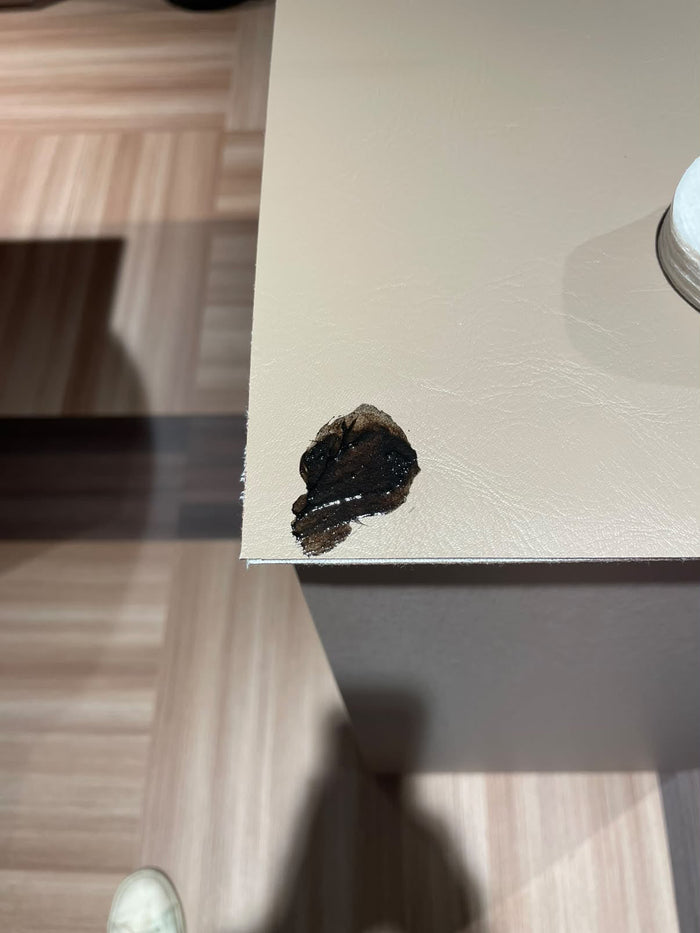
How to remove hair dye from your hairdressing chairs
Got hair dye on the upholstery? See how to remove even a dried stain with bleach, and why the color of your upholstery matters more than you think.
How do you become a cosmetologist in Denmark?
Beautician or cosmetologist? Explore the two routes into the profession in Denmark: the public vocational education and private cosmetologist courses, which schools you can choose from, and what you actually learn along the way.
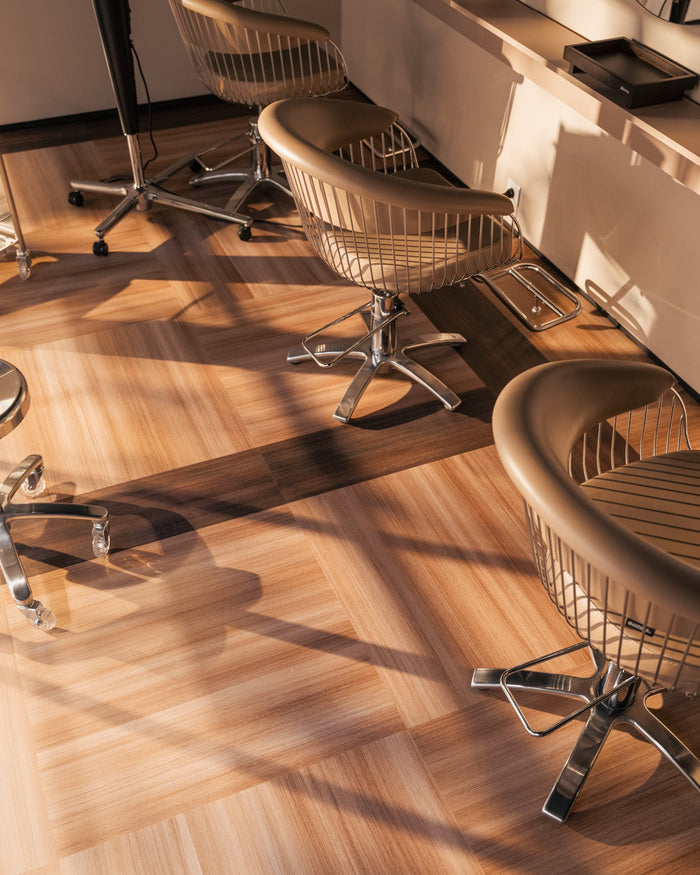
All the equipment a hair salon needs
The complete list of equipment, items and gear a hair salon needs, from a salon stool and mirror to lighting, extraction and towel warmers.
How to choose hotel furnishings for spas and wellness centers
Hotel furnishings require a different approach than a regular salon. See what to choose for the reception, lounge, treatment areas, and storage.
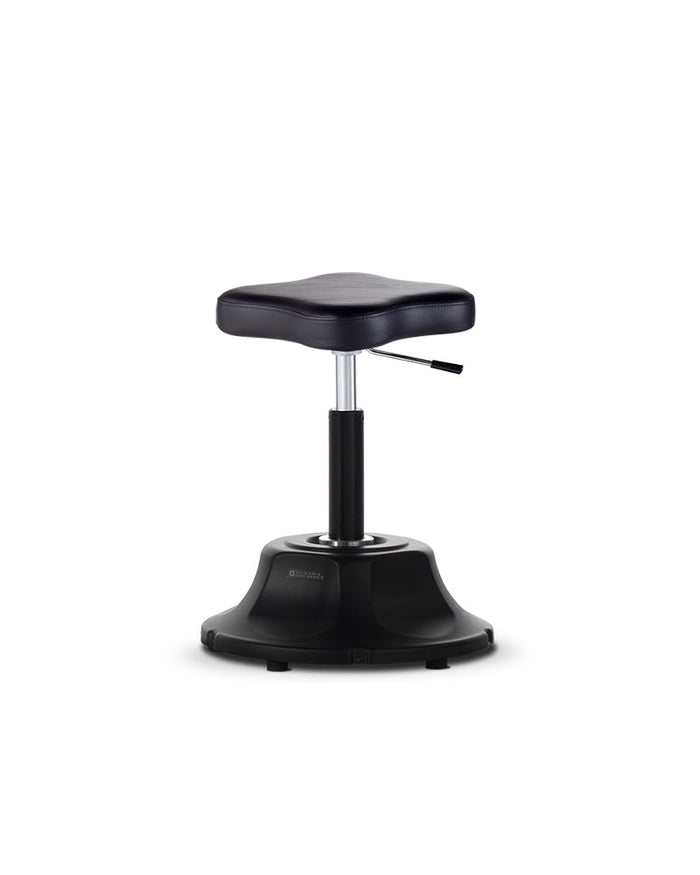
How to choose the right treatment stool
A guide to choosing the right treatment stool if you are a cosmetologist, massage therapist, tattoo artist or acupuncturist—not a hairdresser.
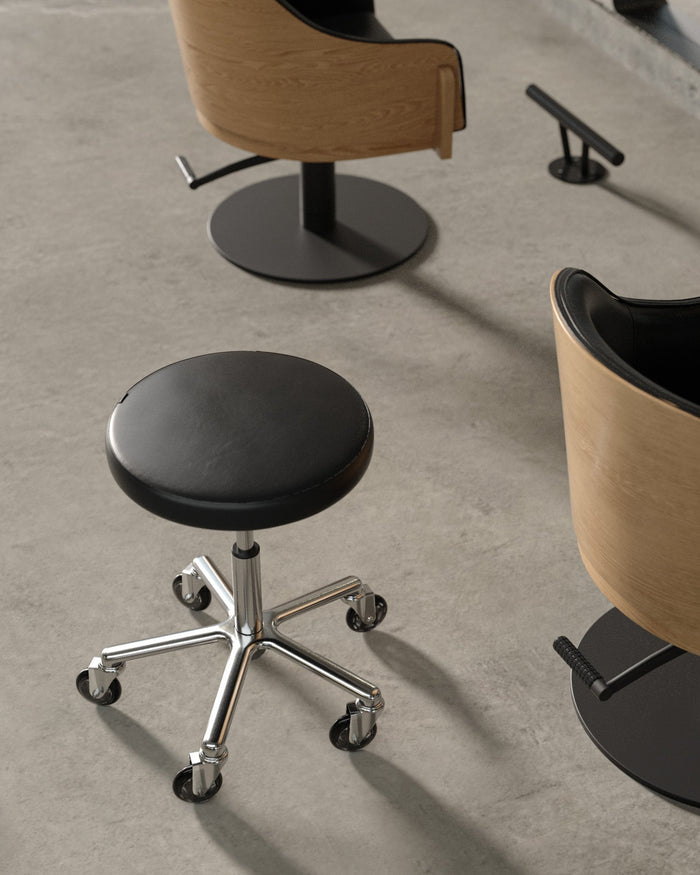
Hairdressing chairs, styling chairs and salon stools: what’s the difference?
If you’ve ever searched for “hairdressing chairs” and ended up looking at a chair for the client instead of yourself, you’re not alone. It’s one of the most common points of confusion in the industry, and we’re clearing it up once and for all. In short: there are two types of chairs in a salon. There’s the chair you sit on. And there’s the chair your client sits on. It sounds simple. But in practice, the terms are often used interchangeably, making it difficult to find the right one when you shop online.